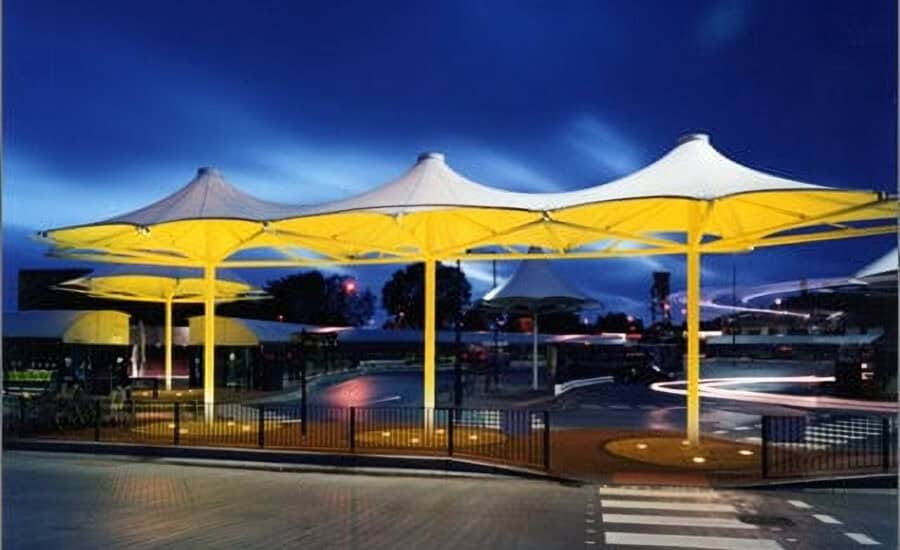
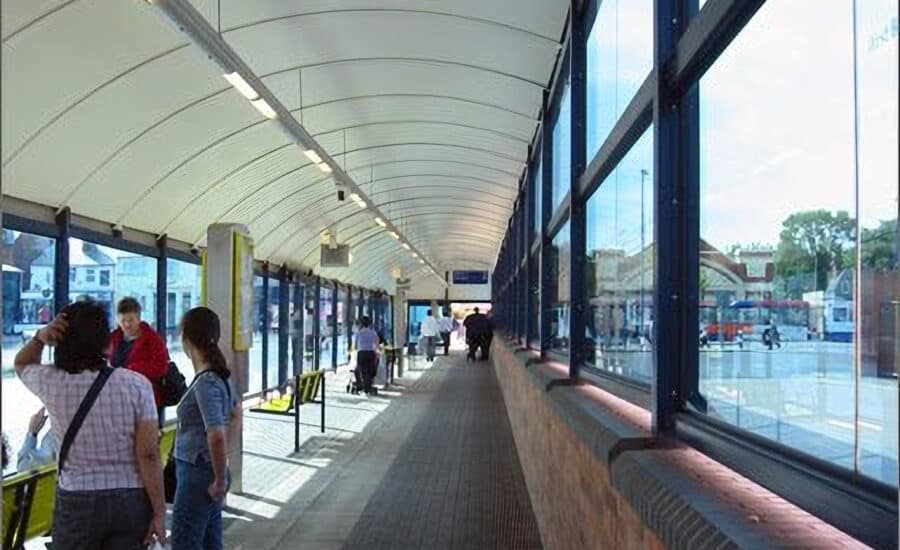
The West Bromwich bus station canopy is a set of conical PVC polyester tensile fabric canopies that Architen Landrell designed, engineered, manufactured and installed for the town’s new bus station, which opened in spring 2002. One 7m and two 9m canopies crown the main passenger building, while a separate triple-cone canopy shelters a second waiting area. Together, they give a functional transport building a distinctive, recognisable roofline, and they helped the station win a national Bus Industry Award in the Infrastructure category.
The new station on Ringway replaced the town’s ageing bus station. The client wanted a safe, welcoming place for passengers to wait, and it wanted to avoid the bland, purely functional look of many transport buildings. The enlarged station can hold 24 buses at once and handles more than 200 bus movements every hour. Today, Transport for West Midlands runs the station, which sits opposite West Bromwich Central tram stop.
The fabric canopies sat at the heart of that brief. For this reason, the project team appointed Architen Landrell to design, manufacture and install the canopies over the main bus shelter building, along with a triple-cone canopy for a separate sheltered area.
Each canopy works much like an umbrella. A central steel mast (or three masts, for the triple cone) carries a series of upper and lower radial spars, and we tension the PVC polyester membrane over this frame.
Because the steel structure is self-supporting and independent of the membrane, it stands on its own. This means our team can install, re-tension or replace the fabric without affecting the frame.
The design team wanted passengers well protected from the weather, so every membrane has a PVDF lacquer finish. This adds an extra protective layer, helps the fabric shed dirt and extends its service life.
In addition, the canopies manage rainwater within the structure itself. Water runs off each membrane to the perimeter connection points, then flows down through the lower radial spars into the central column and out at its base. As a result, runoff stays clear of waiting passengers, and the canopies need no separate gutters.
The canopies use a PVC-coated polyester membrane with a PVDF lacquer finish. Architen Landrell tensioned the fabric over self-supporting steel masts and radial spars.
Rainwater runs to the membrane’s perimeter connection points. From there, it drains down through the lower radial spars and inside the central steel column, then exits at the column base.
Architen Landrell, the tensile fabric and ETFE specialist based in Chepstow, South Wales, carried out the design, engineering, manufacture and installation of all the canopies for the station’s opening in spring 2002.
We have also delivered fabric and ETFE canopies for other UK transport hubs, including Edmonton Green bus station, Northampton Bus Interchange, Birmingham Airport Bus Interchange and Stratford Bus Interchange.
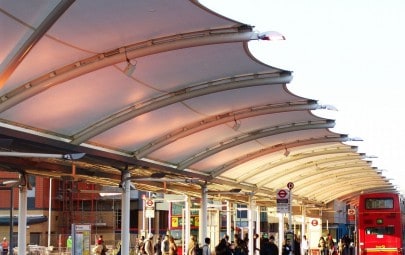
Architen Landrell designed, manufactured and installed the wing-shaped tensile fabric canopy at Edmonton Green Bus...
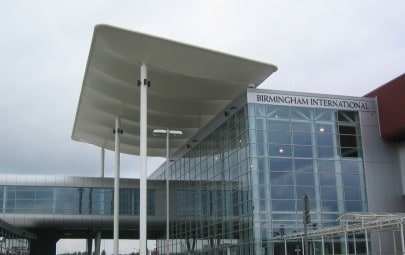
Its long been accepted by architects and designers that the entry points in and out...

In the heart of the capital, local authorities decided to take a brave step and...