
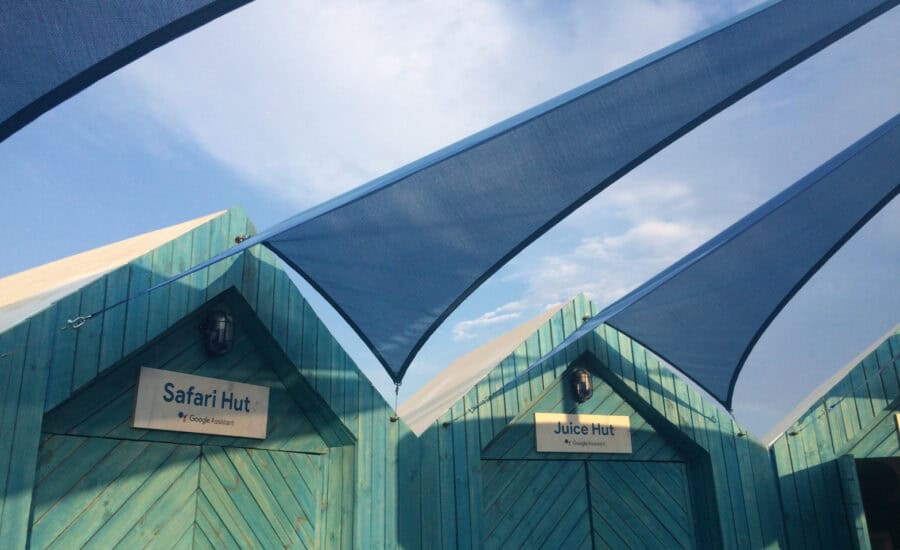
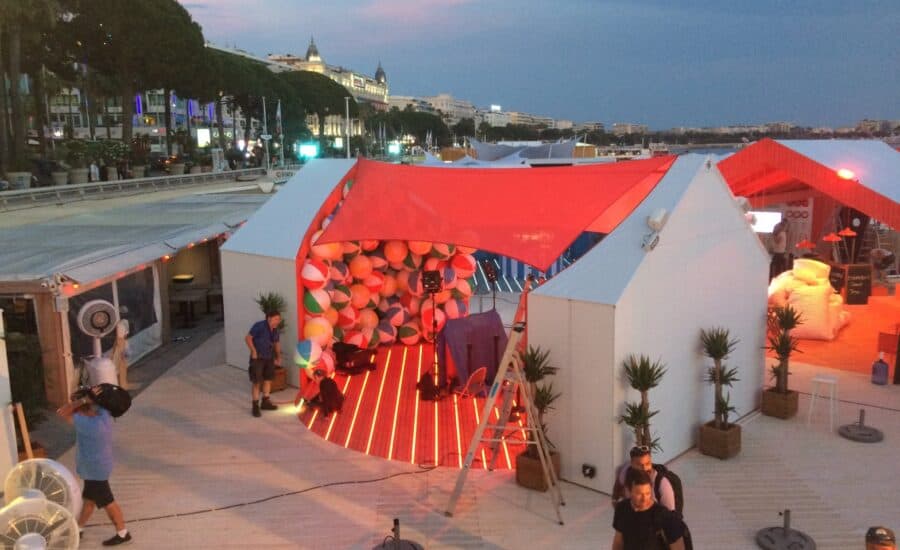
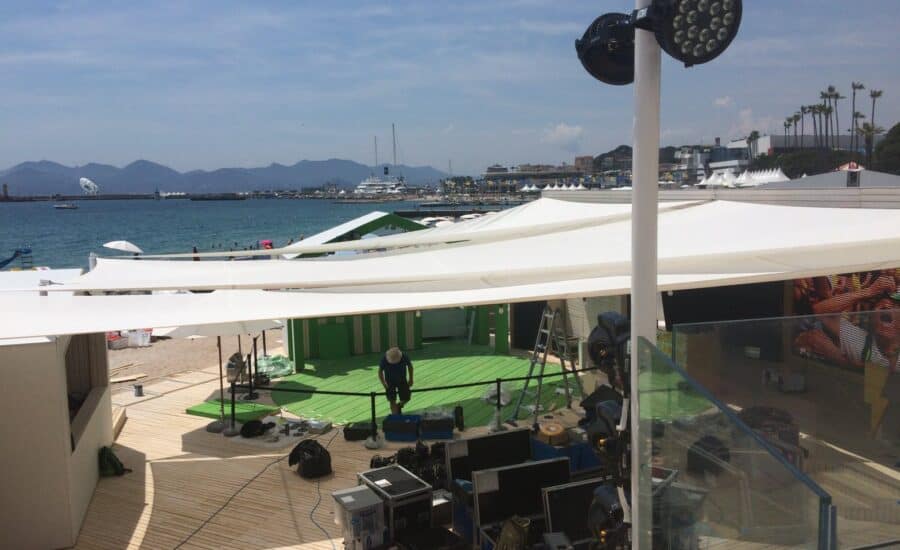
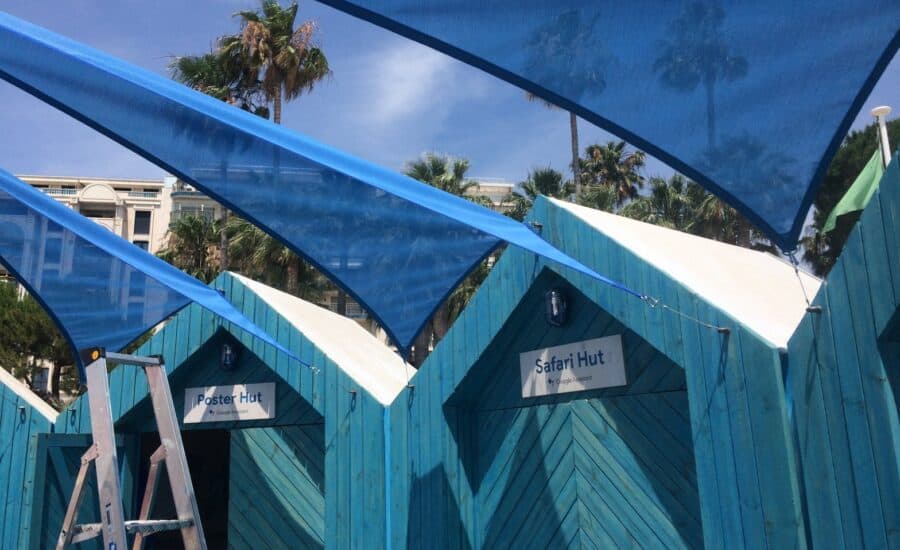
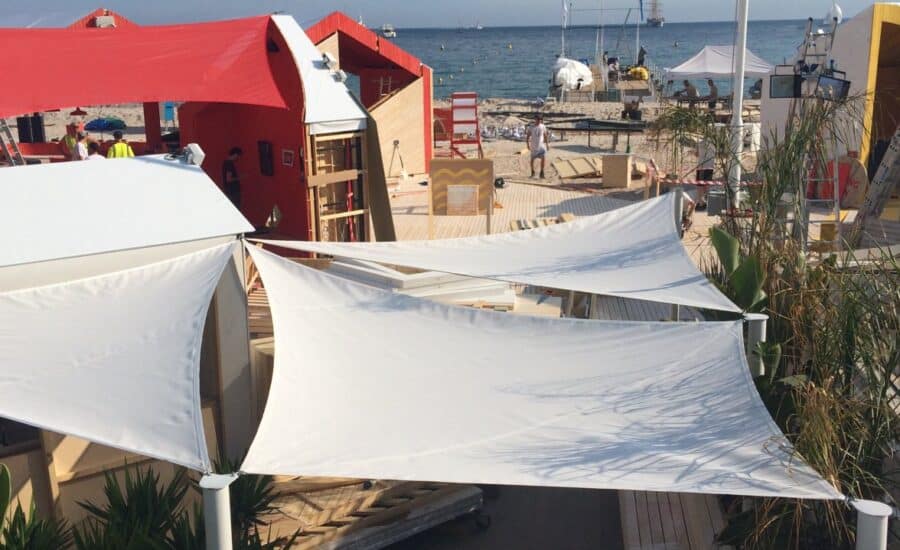
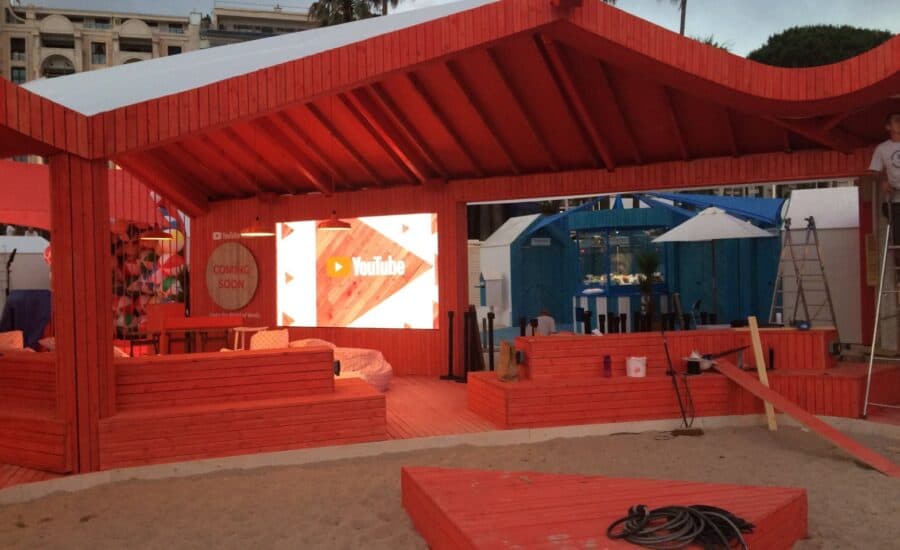
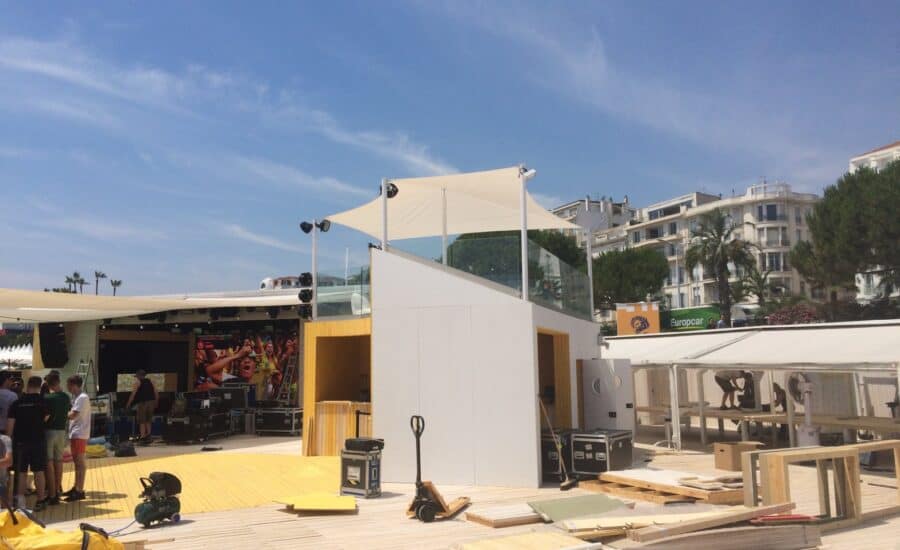
Every June the Cannes Lions festival fills the beaches along the Croisette with brand venues. In 2018 Stage One built Google on the Beach, a village of timber beach huts, bars and stages on the sand, and Architen Landrell designed, made and installed its fabric. That meant shade sails in plain and printed mesh, blackout covers for the main stage, a clear window for the control booth and white PVC roof sheets for seven of the structures: more than 700m² of fabric, made in Chepstow and fitted on the beach in Cannes.
Sail canopies shaded the reception, the beach huts, the YouTube bar, the stages and a rooftop terrace. Most were made from Serge Ferrari Soltis 86, an open-weave PVC-coated polyester mesh that cuts glare and heat but lets air through. The sails over the beach huts and the Pixel GIF booth were printed in strong blue and red, some of them on both sides.
Every sail was finished like a yacht sail: stitched and webbed edges, a curved (scalloped) cut along each side so the sail pulls flat when it is tensioned, and stainless steel eye rings at the corners for the tensioning fittings.
The main stage was enclosed in blackout fabric. Its roof sheets have keder edges all round, with flaps, and its wall sheets have keder on three sides, a pocket and pull-down along the base and a cut-out for the door. A clear PVC panel gave the control booth a view of the stage.
Seven of the timber structures were roofed in white PVC-coated polyester, cut to Stage One’s dimensions. Apart from the stage covers, the fabric was rated M1, the French fire classification that venues in France ask for.
We worked from Stage One’s 3D model of the beach, issued in mid May, and the festival opened on 18 June. The programme allowed about a week for detailed design and two weeks to cut, weld and finish the fabric in Chepstow before it went to Stage One for shipping. Two of our installers then joined Stage One’s crew in Cannes to fit and tension the sails and covers. Stage One built the whole 900m² venue on the sand in five days.
The sails gave the venue shade, colour and shelter through festival week, and everything came down again once the festival was over. Light fabric that packs flat suits short-lived brand venues like this. See more of our temporary and event structures and shade sails and shelters.
What fabric is best for event shade sails?
An open-weave PVC-coated polyester mesh, such as Soltis 86, is a good all-rounder: it cuts glare and heat, lets air through, takes print well and is light to ship. Where the sails must keep rain off, a solid PVC-coated polyester is used instead.
Can shade sails be printed?
Yes. Mesh and solid PVC fabrics can be printed with colours, logos or images, on one side or both. The artwork is laid out around the seams and edges before the sail is made up.
How quickly can fabric for an event venue be made?
For Google on the Beach, design, manufacture and installation took about five weeks from the 3D model to opening day. Lead times depend on size, print and fabric stock, so it pays to involve us early.
Printed fabric cladding for a temporary climbing venue in France In 2024, an international competition...

A tensile fabric structure forms the major element of the eye catching stage set for...

Fabric is a versatile material that can adapt to different seasons and occasions, but it...
