


Acoustic fabrics are open-weave technical fabrics that let sound pass into the air space or absorbent layer behind them, where it is absorbed instead of bouncing back into the room. Architen Landrell designs, makes and installs them in Chepstow, UK, as tensioned ceilings, sails and baffles, wall linings, the inner linings of fabric roofs and outdoor canopies. How much sound a fabric absorbs depends as much on how it is installed (the depth of the air gap, a second layer, or insulation behind it) as on the fabric itself, so we compare tested build-ups, not just fabrics.
While developing the fabric ceiling for DeepMind’s control room, we had two-layer Lightframe panels tested at the University of Salford’s UKAS-accredited acoustic laboratory (BS EN ISO 354, report 3823, June 2018). Each sample had two layers 75 mm apart in a 280 mm deep frame, with no insulation.
| Lower layer | Upper layer | Weight of both layers | αw | Class |
|---|---|---|---|---|
| Batyline mesh | Batyline mesh | 1.4 kg/m² | 0.90 | A |
| Sefar fabric | Batyline mesh | 1.1 kg/m² | 0.85 | B |
| Sefar fabric | Sefar fabric | 0.8 kg/m² | 0.80 | B |
| ETFE foil | Batyline mesh | 0.9 kg/m² | 0.60 | C |
| ETFE foil (380 mm deep frame) | Batyline mesh | 0.9 kg/m² | 0.55 | D |
Two layers of open fabric gave the best results, up to Class A without any insulation. Swapping one layer for ETFE foil, which is airtight, brought absorption down to Class C or D.
| Fabric | Tested absorption | Fire classification | Good for |
|---|---|---|---|
| Serge Ferrari Tenseo Comfort AW (620 g/m²) | αw 0.65 (NRC 0.65) on a frame with a 100 mm or 400 mm air gap; αw 1.00 (NRC 0.95 to 1.00) with 45 mm or 100 mm of mineral wool behind | B-s2,d0 (EN 13501-1) | Tensioned ceilings, baffles, wall panels, glass-roof blinds, luminous ceilings |
| Serge Ferrari Tenseo Comfort SW (900 g/m², 1.2 mm) | αw 0.65 (NRC 0.65) | B-s2,d0 (EN 13501-1) | Outdoor canopies and large ceilings and walls exposed to UV and moisture, such as stadiums |
| Acoustis 50, coated glass fibre (410 g/m², 0.7 mm) | αw 0.30 to 0.75 depending on how it is hung: 0.30 as a curtain 25 mm from a wall, 0.55 at 175 mm, 0.70 as screen panels with a 300 mm gap, 0.75 stretched over a vertical frame | M1 (French classification) | Swimming pools and wet areas (it is washable and not affected by water spray), roll-up acoustic blinds |
| Batyline mesh, two layers in a Lightframe panel | αw 0.90 (Class A), tested as above | Depends on the grade | Lit and unlit fabric ceilings |
Figures for Serge Ferrari and Acoustis fabrics are the manufacturers’ published test results. We can advise on other acoustic fabrics, foams and liners for a particular space.
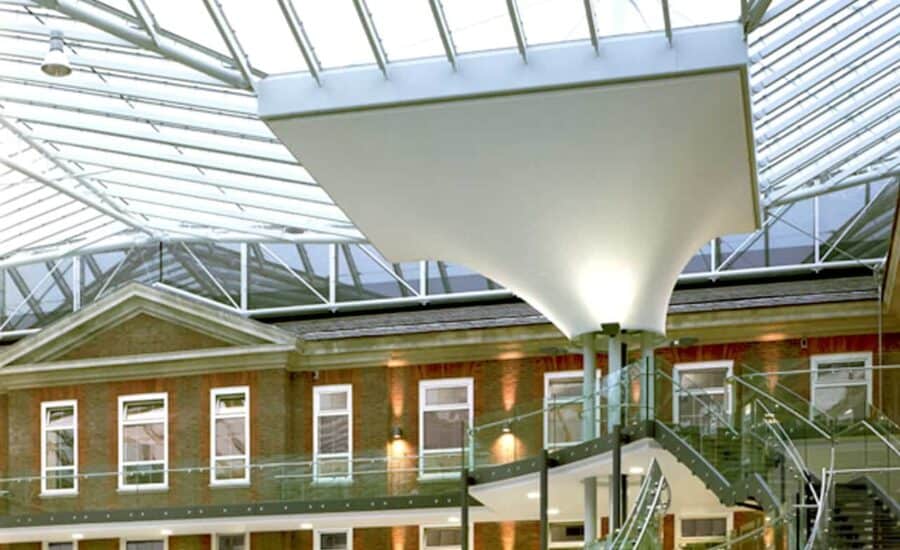
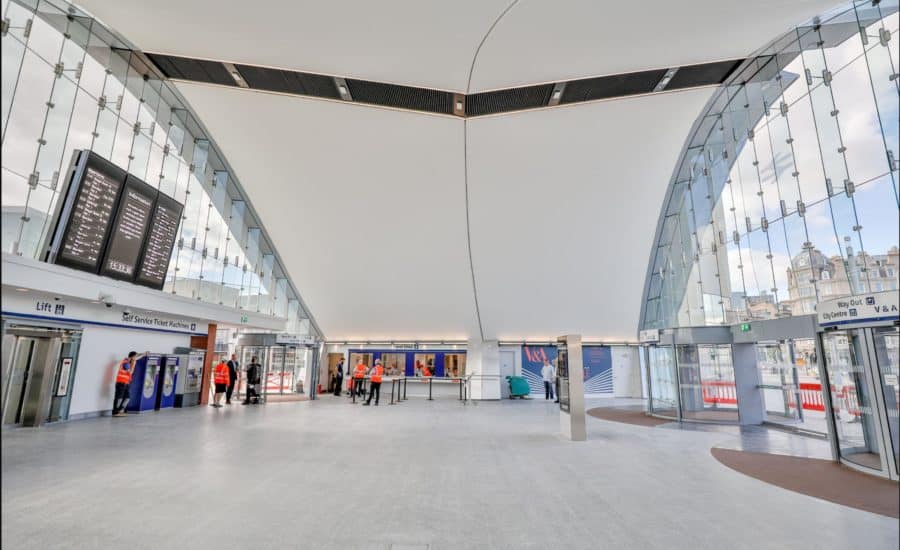
Glass, concrete and hard floors bounce sound around a room, so atriums, offices, stations and halls echo. Any mesh fabric helps, and acoustic fabrics, or an absorbent layer behind the fabric, do much more. Because the same fabric can also shade, diffuse light and look good, one ceiling or sail can solve several problems at once. Examples:
See fabric interiors for ceilings, sails and screens.
Fabric over a busy space can absorb sound as well as shelter it. Outdoor grades such as Tenseo Comfort SW are made for weather exposure. For the ABBA Arena concourse canopies we specified a weldable PVC foam membrane that gives both thermal and acoustic insulation in the main gathering space. Insulated fabric roofs can also take an acoustic inner lining.
Heavy rain can make ETFE cushions drum. A tensioned polyester mesh fixed over the top layer, in the same clamping system, damps the foil and holds a film of water, reducing rain noise by up to 10 dB. It can be added during installation or retrofitted later. See ETFE roofs and the rain suppression data sheet below.
How much sound can an acoustic fabric absorb?
The build-ups we use range from αw 0.30 to 1.00. Two layers of open fabric in a Lightframe ceiling reached αw 0.90 (Class A) in tests at the University of Salford, and a single acoustic fabric with mineral wool behind it can reach 1.00.
Do acoustic fabrics stop sound passing between rooms?
No. They absorb sound and cut echo within a space. Stopping sound passing through a wall or roof needs mass and airtight layers. On ETFE roofs a rain suppression mesh reduces rain noise by up to 10 dB.
Can acoustic fabric be added to an existing building?
Yes. Sails, baffles and ceilings hang from or fix to the existing structure, and the ETFE rain mesh can be retrofitted to existing cushions.
Can acoustic fabrics be used outdoors?
Yes. Outdoor grades such as Tenseo Comfort SW (αw 0.65) resist UV, moisture and mould.
To discuss acoustic fabric for a project, contact us or call 01291 638200.
| Exterior / Interior | Life Expectancy | Translucency | Recyclable | Frequency of Maintenance | Cost | Fire Rating | |
|---|---|---|---|---|---|---|---|
| PVC Polyester | Exterior |  | | Yes | | | |
| Silicone Glass | Both | | | Yes | | | |
| PTFE Glass | Exterior | | | No | | | |
| ETFE | Exterior | | | Yes | | | |
| Tenara | Exterior | | | No | | | |
| PVC Glass | Interior | | | No | | | |
| Stretch Fabric | Interior | | | No | | | |
In the centre of Hendon Quadrangle, at Middlesex University, Architen Landrell installed four twin skin...
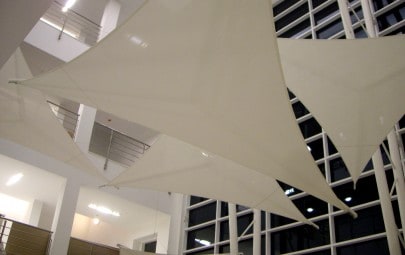
Vast atriums with glass ceilings look great but can suffer from solar glare and poor...

Sitting on the edge of the waterfront in central Dundee, a five storey curved-fronted building...
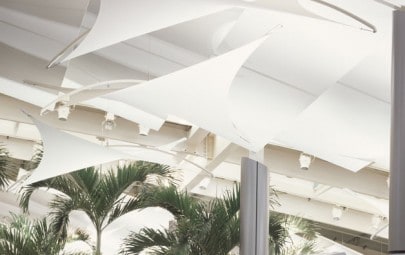
Architen Landrell was approached to design, manufacture and install bespoke ceiling and wall linings for...

In an attempt to dispel the antiquated view of the science lab as pristine, insular...
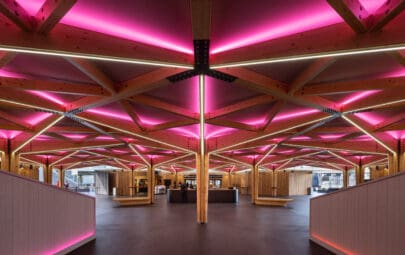
A tensile fabric canopy with high acoustic performance and a touch of Swedish design was...
